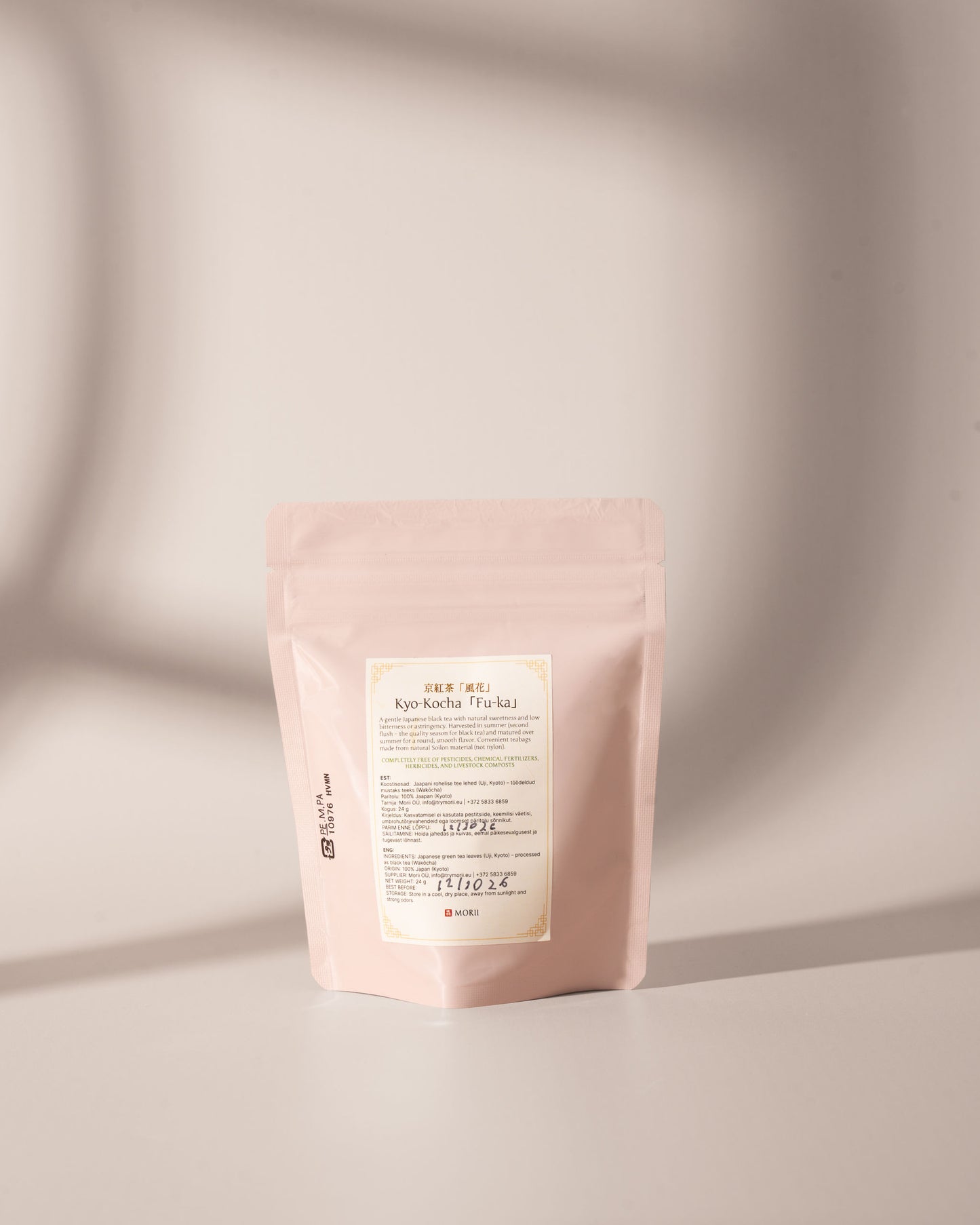
Kyoto Black Tea, or kyo-kocha, is a rare thing: black tea made in the heart of Japan's green-tea country, from the same bushes that give our sencha. Fully oxidised but gentle, it has the natural sweetness and low astringency Japanese black teas are known for, so it needs no milk and no sugar. Eight pyramid bags of whole leaf from Morii Farm in Kizugawa, Kyoto.
Black tea from green-tea cultivars
Kyoto grows almost nothing but green tea, and only a handful of farms there make black tea at all. Morii Farm makes this one from Yabukita and Sayamakaori, cultivars bred for green tea, which is why the cup is soft and sweet rather than tannic. The leaf is picked in summer, the farm's only summer harvest, when the warmth gives black tea its best aroma. Freshly made black tea is a little rough, so the farm rests it for one season before packing; by autumn it has rounded out.
Grown without pesticides, in summer
Summer is when pests are most active, which is why most farms spray. Morii Farm keeps extra fields in reserve for black tea and picks only the ones that came through the season clean. Yields vary; the practice does not.
Taste
Honey, dried apricot, a little malt and a hint of roasted sweet potato, with a silky texture and almost no astringency. Closer to a Darjeeling second flush than to an Assam. Cold-brewed it is bright and fruity.
How to brew
Hot: one pyramid bag per 250–300 ml with water just off the boil, 2–3 minutes. A second steep of 3–4 minutes still has plenty to give. Cold brew: one bag per 500 ml of cold water, 6–8 hours in the fridge. Serve plain; milk and sugar hide what makes it special.
Good to know
8 bags of 3 g, about 16 cups counting re-steeps. Roughly 30–50 mg of caffeine per cup, similar to other black teas and about half a coffee. Keeps well: airtight, away from light, a year or more.
From Morii Farm, Kizugawa, Kyoto
Every tea in our online shop comes from one farm. Morii Farm is a small family farm in Kizugawa, in the hills of southern Kyoto Prefecture next to the Kizu River, run by Masakazu and Tomomi Morii, the fourth generation on this land. The slopes are steep and the gap between day and night temperatures is wide, which slows the leaves down and concentrates their sweetness. Since 2017 the fields have been managed without pesticides, chemical fertilizers, herbicides or animal manure; the only fertilizer is natural rapeseed cake. This is the farm's own practice, not a certification, and it is the reason our teahouse in Tallinn carries the family name.
Frequently asked questions
What is Japanese black tea (wakocha)?
Black tea grown and fully oxidised in Japan, usually from cultivars bred for green tea. It is softer, sweeter and less tannic than Indian or Sri Lankan black tea. Kyo-kocha means black tea from Kyoto.
Does Kyoto Black Tea need milk or sugar?
No. It is naturally sweet and low in astringency, and the farm recommends drinking it plain. If you like milk tea, it works, but you lose the fruit notes.
How much caffeine does it have?
Roughly 30–50 mg per cup, in line with other black teas and about half a filter coffee (around 90 mg).
What does it taste like compared with Assam or English Breakfast?
Much gentler. Honey, apricot and malt instead of strong tannin, and a silky texture. If English Breakfast is a shout, kyo-kocha is a conversation.
Can I cold-brew the tea bags?
Yes: one bag per 500 ml of cold water, 6–8 hours in the fridge. It comes out clear, fruity and slightly sweet.
Why is Japanese black tea rare?
Black tea is a tiny fraction of Japan's tea output, and Kyoto makes even less of it; the region built its name on green tea. Only a few growers have the fields and patience for it, and volumes are small every year.
How many cups do I get from 8 bags?
Each 3 g bag steeps at least twice, so about 16 cups.
How fast does it ship, and what does delivery cost?
Orders ship within 24 hours from Tallinn, Estonia. Estonia: Omniva parcel locker €2.95, free from €50. Latvia and Lithuania: €4.95–5.95. Finland: Matkahuolto €7.95. Elsewhere in the EU: free shipping from €75. Pickup at Morii Teahouse, Kopli 16, Tallinn (Mon–Sat 12–21, Sun 12–20) is usually ready the same day, and you can taste the tea before you take it home.