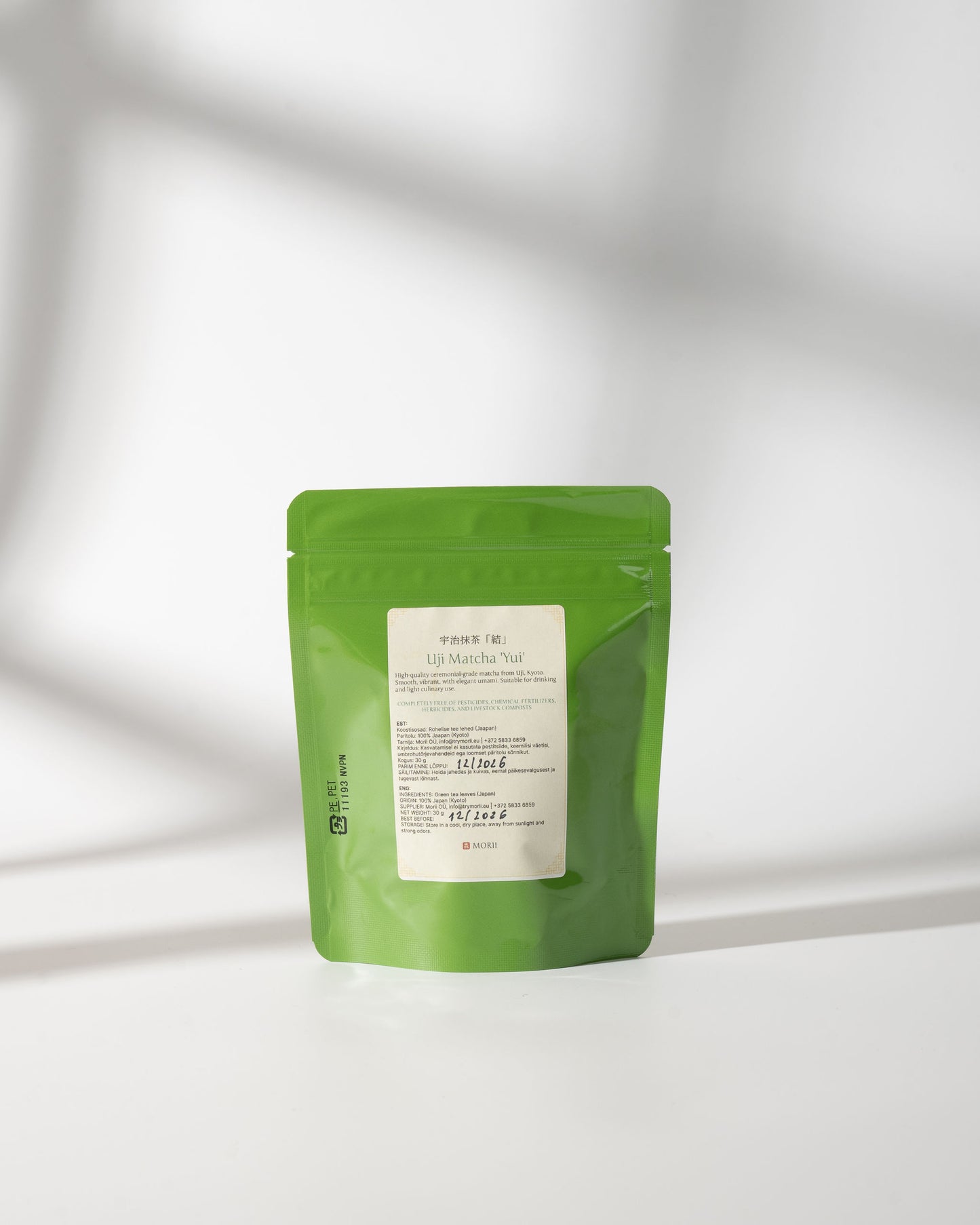
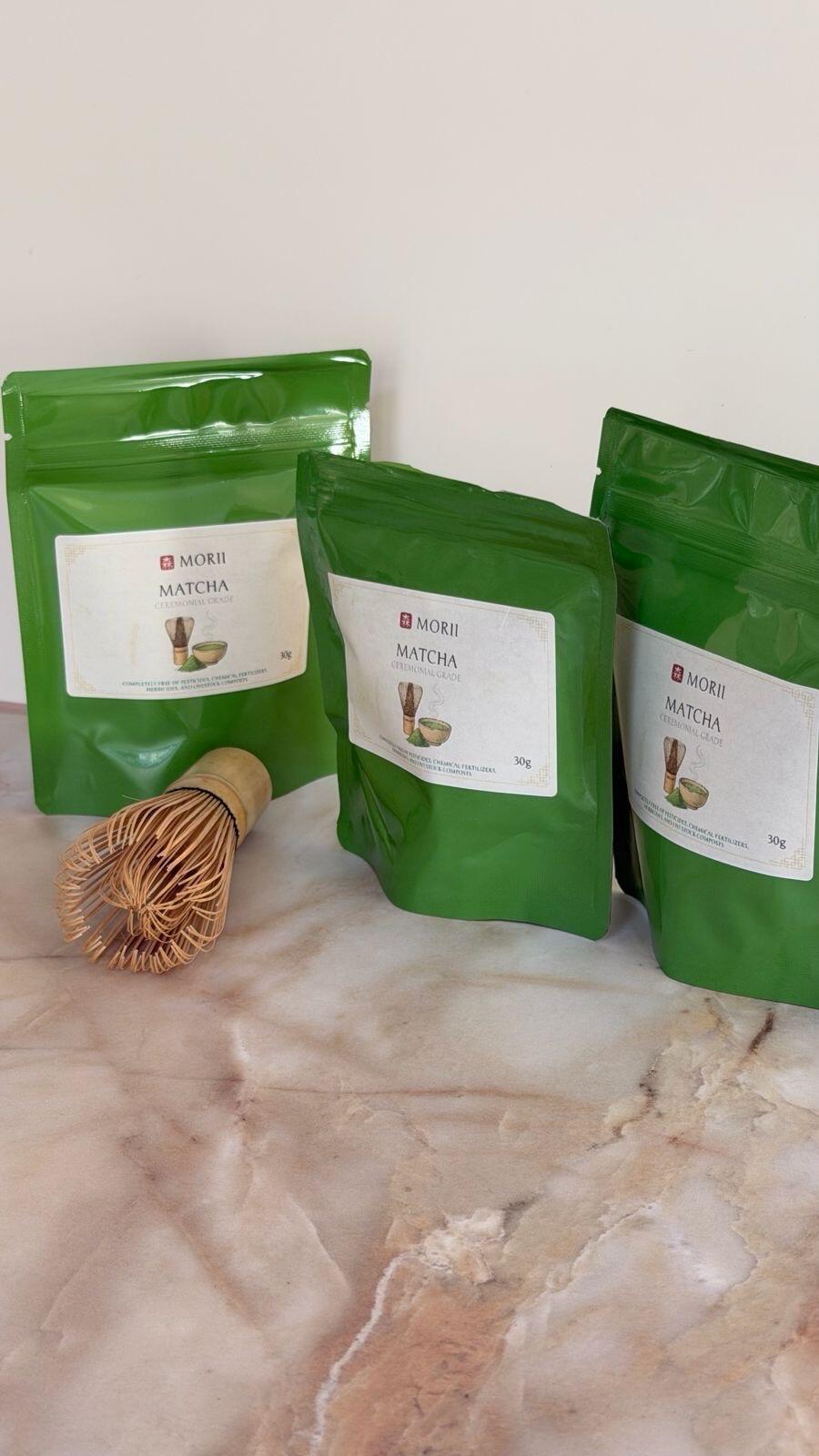
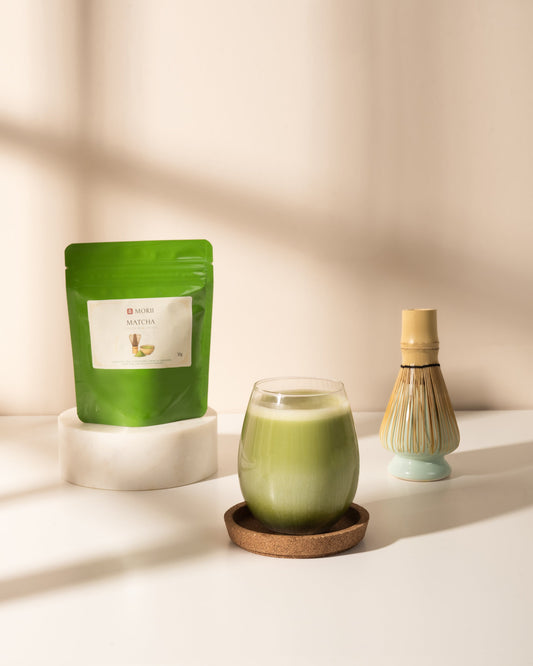
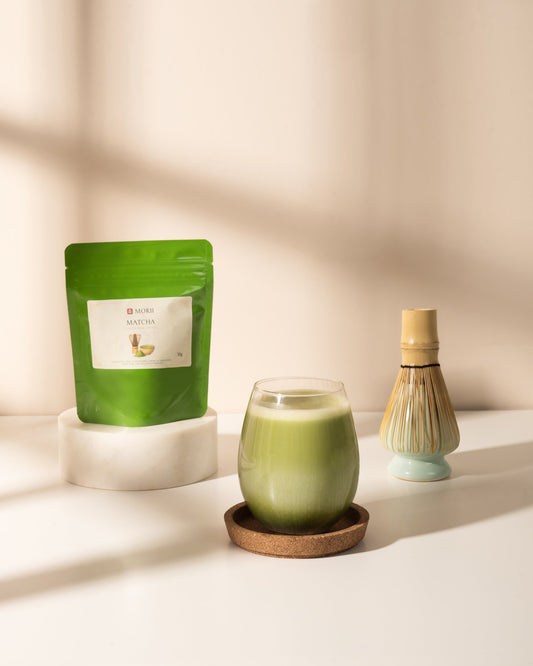
Matcha Yui is a single-farm, first-flush matcha grown and milled by Morii Farm in Kizugawa, Kyoto. It is shaded for about three weeks before the one spring harvest, rested over summer as tencha, then milled slowly for around 30 hours into a micro-fine powder. The result is a bright green bowl with deep umami, natural sweetness and no bitterness when prepared with 70–80 °C water.
What makes it different
Most matcha sold as “Uji matcha” is a blend of leaf from several prefectures and several harvests. Yui is one farm, one field system, one harvest a year. The farm never picks a summer crop from the matcha fields, so every gram is first flush (ichibancha), the harvest with the highest theanine and the least astringency. The colour is the leaf's own; nothing is added to deepen it.
Shaded, rested, milled slowly
About three weeks before harvest the bushes are covered with shading net. Less light means the plant keeps its theanine instead of converting it to catechins, which is where the sweetness and the savoury depth come from. After harvest the leaves are steamed and dried into tencha and stored through the summer, which rounds off the sharp edges of fresh tea. Milling is deliberately slow, around 30 hours per batch, so the powder never heats up; heat is what turns matcha dull and flat.
Taste
Sweet and savoury first, a soft grassy middle, a clean finish with no dryness. Whisked thin (usucha) it is lively; whisked thick (koicha) it is dense and almost broth-like. In a latte it keeps its flavour instead of disappearing into the milk.
How to prepare it
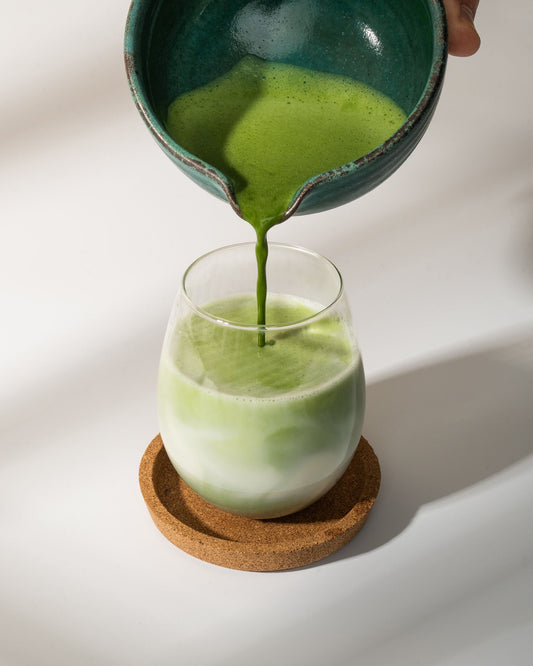
Whisked (usucha): sift 1.5–2 g into a bowl, add 70–80 ml of water at 70–80 °C and whisk in a fast M or W motion until a fine foam covers the surface. Simple cup, the farm's way: stir 1 g into 150 ml of hot water; no whisk, no foam, a light everyday matcha. Latte: 2 g of matcha, 30 ml of hot water, whisk, then top with 150–200 ml of milk, hot or over ice. Ice shake: put ice in a bottle first, then 2 g of matcha, then cold water; shake for 20 seconds. The ice breaks up the powder the way a whisk would, and there is nothing to wash. Sparkling: dissolve 3–5 g in a little water and top with soda; add a slice of citrus. In the kitchen: fold into whipped cream, yoghurt, ice cream or a cheesecake base. Low-temperature desserts show the flavour best.
Good to know
A 2 g bowl contains roughly 60–70 mg of caffeine, about the same as a small espresso, released more gently because of the theanine. The European Food Safety Authority considers up to 400 mg of caffeine a day safe for healthy adults and up to 200 mg during pregnancy. 30 g makes about 15–20 bowls or 15 lattes. Store airtight, away from light and heat; after opening keep it in the fridge and use it within two months.
From Morii Farm, Kizugawa, Kyoto
Every tea in our online shop comes from one farm. Morii Farm is a small family farm in Kizugawa, in the hills of southern Kyoto Prefecture next to the Kizu River, run by Masakazu and Tomomi Morii, the fourth generation on this land. The slopes are steep and the gap between day and night temperatures is wide, which slows the leaves down and concentrates their sweetness. Since 2017 the fields have been managed without pesticides, chemical fertilizers, herbicides or animal manure; the only fertilizer is natural rapeseed cake. This is the farm's own practice, not a certification, and it is the reason our teahouse in Tallinn carries the family name.
Frequently asked questions
What is ceremonial-grade matcha?
There is no official grading system in Japan. We use “ceremonial grade” to mean matcha that is good enough to drink whisked with only water: first-flush leaf, shaded before harvest, milled fine enough to foam. Yui meets all three. It is also excellent in lattes; the grade is about the leaf, not the drink.
Is this real Uji matcha?
Uji tea is the regional name for tea grown in the Kyoto area and finished with Kyoto methods. Yui is grown entirely in Kyoto Prefecture, in Kizugawa in the Yamashiro hills south of Uji city, on Morii Farm, and it is not blended with leaf from other prefectures. Most matcha labelled Uji cannot say that.
How much caffeine is in matcha compared with coffee?
A 2 g bowl of matcha has roughly 60–70 mg of caffeine; a 200 ml cup of filter coffee has around 90 mg and an espresso around 80 mg. Matcha also contains L-theanine, which is why most people describe the effect as calm focus rather than a spike.
Can I drink matcha during pregnancy?
The European Food Safety Authority advises keeping caffeine under 200 mg a day during pregnancy. One bowl of Yui is about 60–70 mg, so one bowl a day fits within that limit. Ask your doctor or midwife if you are unsure.
Why does some matcha taste fishy or bitter?
Bitterness usually means the water was too hot or there was too much powder for the water. Fishy or seaweed notes come from oxidised or late-harvest leaf. Yui is first flush and shipped in small batches, and it is sweet at 70–80 °C. Keep it sealed and cold once opened and it stays that way.
How much matcha do I use per cup?
1.5–2 g (about one bamboo scoop or half a level teaspoon) for a whisked bowl, which is what the farm recommends for the traditional cup; 1 g in 150 ml of hot water for a light everyday cup; 2 g for a latte; 3–5 g for sparkling matcha or baking. 30 g is roughly 15–20 whisked bowls or 30 light cups.
Do I need a bamboo whisk?
A chasen gives the finest foam, but a small electric milk frother works, and the ice-shake method in a bottle needs no tools at all. Sift the powder first and lumps disappear.
How long does matcha keep, and how should I store it?
Unopened and cool, about a year. Once opened, seal it tightly, keep it in the fridge away from strong smells and use it within two months; light and air fade both colour and sweetness.
Does matcha affect my period?
Matcha itself does not change the cycle, but two things about it matter during menstruation. Caffeine: a 2 g bowl has 60–70 mg, and some women notice that caffeine makes cramps or breast tenderness worse in the first days, so a smaller serving or a hojicha latte is a good swap then. Iron: periods are the main reason iron deficiency is more common in women, and tea reduces how much iron you absorb from food when you drink it with a meal, so during and just after your period, drink matcha between meals rather than with them. If your periods are heavy or you tire easily, ask your doctor to check your ferritin.
Does matcha block iron absorption?
Partly, and only around meals. The catechins and tannins in green tea bind the non-heme iron found in plants, grains and supplements, and can cut its absorption by roughly a third to a half when the tea is drunk with the meal. Coffee does the same, hot or iced. Heme iron from meat and fish is barely affected. The fix is timing: have matcha at least an hour before or after iron-rich meals or iron tablets, and pair those meals with vitamin C, which pulls absorption back up.
I have low iron. Can I still drink matcha?
Most people with low iron can, as long as the matcha is not drunk with the meal. Iron deficiency is common in women of menstruating age, and low ferritin shows up as tiredness, hair shedding, feeling cold and heavier or irregular periods, which is why the question comes up so often. Keep matcha between meals, take any iron supplement with orange juice rather than tea or coffee, and follow your doctor's plan for the deficiency itself; matcha does not cause it, but drinking it at the wrong time can slow the recovery.
When was this matcha harvested?
Morii Farm harvests the matcha fields once a year, in spring. The tencha rests over the summer and is milled in small batches through the year, so a spring harvest is drunk until the next one has rested and been milled; that is normal practice in Kyoto, and it is why the leaf is stored as whole tencha, not powder.
How fast does it ship, and what does delivery cost?
Orders ship within 24 hours from Tallinn, Estonia. Estonia: Omniva parcel locker €2.95, free from €50. Latvia and Lithuania: €4.95–5.95. Finland: Matkahuolto €7.95. Elsewhere in the EU: free shipping from €75. Pickup at Morii Teahouse, Kopli 16, Tallinn (Mon–Sat 12–21, Sun 12–20) is usually ready the same day, and you can taste the tea before you take it home.